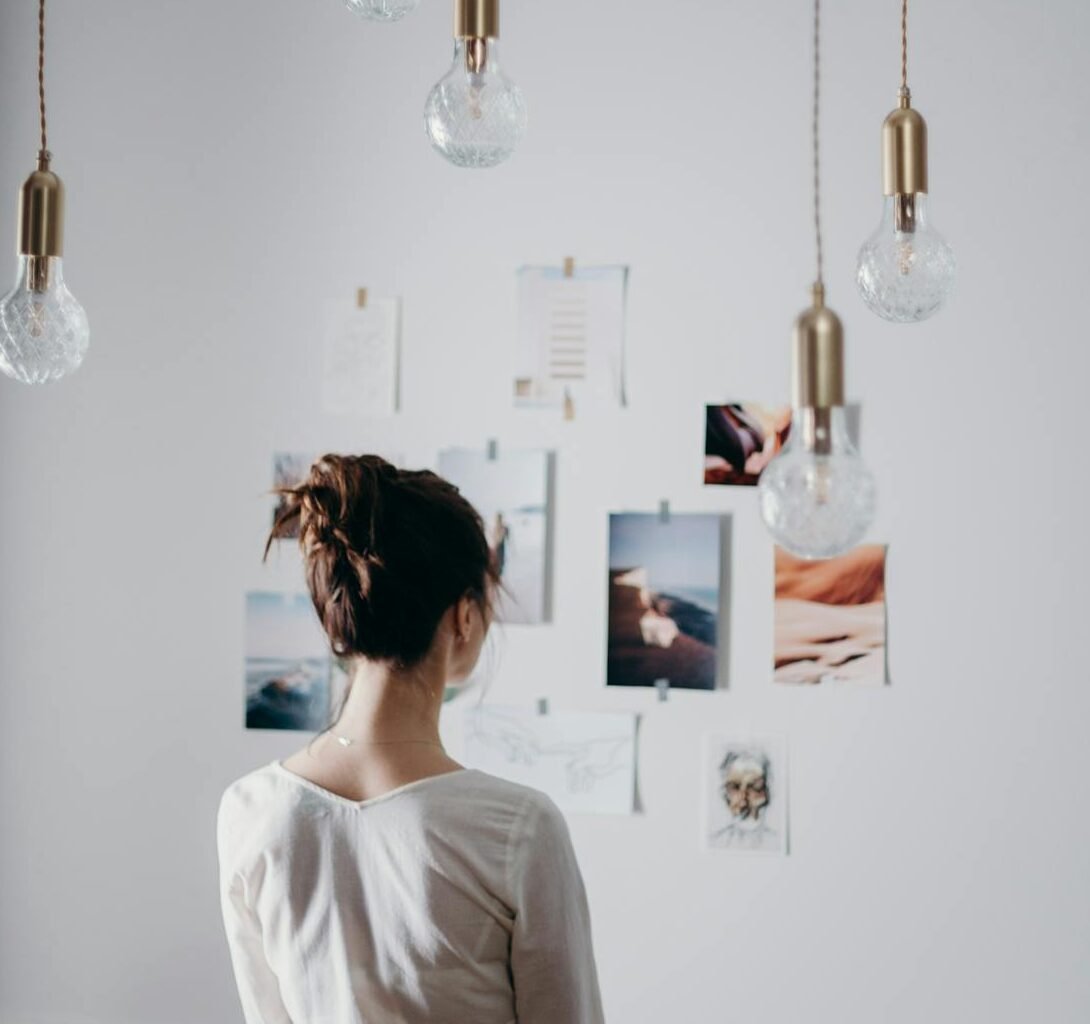
We’ve all done it. Spent an evening on Pinterest collecting images of beach houses and dream kitchens, maybe made a Canva collage, set it as a phone background, felt that small surge of optimism. By February we’d changed the wallpaper to something else and forgotten the whole thing.
It’s not a commitment problem. There are two reasons these boards rarely work, and neither of them is you. The first is how we make them. The second is what we put on them.
Research from NYU psychologist Gabriele Oettingen explains part of it. When we vividly imagine achieving a goal, our brains experience a kind of premature satisfaction. Blood pressure drops. Motivation decreases. We’ve already “arrived” before we started. The Pinterest board becomes the reward. The actual work? Optional, apparently.
But there’s a version that works differently. It’s slower, less photogenic, and asks more of us. It also has proper research behind it, which helps when the whole thing starts to feel a bit woo-woo.
Why analog changes everything
A 2024 study from the Norwegian University of Science and Technology found that handwriting creates “far more elaborate” brain connectivity than typing. Not a little more. Far more. When we write by hand, we engage regions responsible for memory, sensory processing, and encoding new information. Typing barely registers in these areas.
This matters because the format shapes what happens next. A digital board is fast to make and easy to forget. We drag images into a folder, add some text, feel briefly inspired, and we’re done in twenty minutes. That speed is the problem. We haven’t spent enough time with any of it for the ideas to actually stick.
An analog board is slower by design, which sounds like a disadvantage until you realise it’s the whole point. When we cut an image from a magazine, we’ve already engaged with it more deeply than clicking “save.” When we arrange things by hand, move them around, glue them down, we’re using the motor-visual feedback loop that strengthens memory. The friction isn’t a flaw. It’s what makes the thing work.
Plus there’s something satisfying about scissors and glue. A bit primary school, but satisfying.
What actually belongs on it
But before you grab the magazines and start cutting: a physical board alone won’t save you either. We’ve all made those too. Spent an afternoon with scissors and glue, felt very intentional about it, stuck it on the wall. By March it was just part of the furniture. Our eyes stopped seeing it entirely.
The format is only half the problem. The other half is what we put on it.
Think about the last vision board you made. What was on it?
Probably something like this: a beautiful house, a dream holiday, a number in a bank account, maybe a wedding or a promotion or a body that looks different from yours. Big, shiny, far away.
Now think about what wasn’t on it. Your morning. Your commute. The way you spend a Wednesday evening. The stuff that actually makes up 90% of your life.
That’s the gap. We build boards full of destinations and forget we have to live in the journey. No wonder they don’t work. We’re visualising a future that has almost nothing to do with how we spend our actual days.
The standard vision board is all dream, no action. We make one in January and never look at it again. By spring it’s just decoration.
Neuroscientist Dr Tara Swart prefers calling them “action boards” for exactly this reason. The name reminds us that the work is still ours. A board full of outcomes with no sense of what’s actually in the way is just decoration with better lighting.
What else is usually missing: First, journaling before the board. Most of us haven’t separated what we genuinely want from what we think we should want. Without that, we end up with a collage of borrowed ideas and inherited expectations. Very aesthetically cohesive. Not very useful. Second, obstacles. A board that only shows the destination lets our brain relax, as if the journey is already done. The research calls this “mental contrasting,” and including obstacles dramatically increases follow-through. Third, a return ritual. A board we look at once and forget is just art. The practice is in the returning.
Tuesdays, not destinations
Instead of filling a board with big goals, fill it with tiny snapshots of what you want your daily life to look like. Not the destination. The texture of ordinary days.
We call it an “evidence board” because that’s what it becomes by December.
The images represent behaviours, not outcomes. Small, ordinary moments we want more of.

 sia.bartrum@gmail.com
Say we want to be more active this year. The usual board might have images of someone crossing a marathon finish line, a perfect gym body, expensive trainers. Aspirational and distant. An evidence board has something different: a water bottle on a desk, a walking path, someone stretching in the morning, a yoga mat rolled out in a living room. These aren’t dreams. They’re Tuesdays.
Say we want to be more active this year. The usual board might have images of someone crossing a marathon finish line, a perfect gym body, expensive trainers. Aspirational and distant. An evidence board has something different: a water bottle on a desk, a walking path, someone stretching in the morning, a yoga mat rolled out in a living room. These aren’t dreams. They’re Tuesdays.
The key is specificity. Not “travel” but a particular café table in a particular kind of light. Not “health” but a morning walk with a podcast. Not “success” but a tidy desk at 6pm with the laptop closed.
Instead of showing us how far we have to go, it shows us what we’re trying to build into ordinary life. The distance between here and there starts to look manageable.
A three-part ritual
Before you touch any images, write.
Sit with a notebook and answer a few questions honestly. What am I pretending not to want? What would I pursue if no one could see my choices? What story about myself am I ready to let go of?
This takes fifteen minutes and changes everything that follows. Most of our vision boards are full of things that look good rather than things that actually matter to us. The writing sorts that out. It’s also slightly uncomfortable, which is how you know it’s working.
Build the board with both sides visible.
Gather magazines, printed photos, scissors, glue, and one large sheet of card. Give yourself an hour or so, uninterrupted, phone in another room. Make it nice. Tea, good light, no rushing.
Structure it in two halves. On the left, what you want your daily life to look like. Images, words, textures. Be specific. A particular kind of morning, not “peace.” A feeling you can name, not a quote from someone else’s Instagram. Focus on behaviours and moments, not achievements. On the right, what’s in the way. Fears, habits, practical barriers. Write them or represent them with images. This is the Oettingen method made visible: what we want plus what’s blocking us. That combination is what actually moves us forward. One side without the other is just wishful thinking with better design.
Return to it weekly. And replace as you go
A board on the wall becomes invisible within two weeks. Our eyes stop registering it entirely. So we need a short ritual, same time each week. Sunday mornings work well.
But what makes this version different from the usual “look at your board and feel inspired” advice: the goal is to recreate the images using photos from your own life.
Each month, pick a few images from your board and ask: could I actually live this moment this month? Not in some distant future. This month. When you catch yourself living one of those moments, take a photo. Your morning coffee in good light. Your actual desk, tidied. Your real walking route.
Then, throughout the year, replace the original inspiration images with the photos from your own life.
By December, a board that started as aspiration has become evidence. You’re not dreaming about a life anymore. You’re looking at proof that you’re already living parts of it.
Most of us are so focused on the gap between here and there that we miss how much has already changed. The replacement ritual fixes that. It teaches us to notice the ways we’re already living what we once only imagined.
What to include, what to leave off
Put on: images of daily moments and behaviours, words in your own handwriting, one uncomfortable truth, textures or objects that mean something to you. A fabric swatch. A ticket stub. Something that wouldn’t make sense to anyone else. The weirder, the better, honestly.
Leave off: big achievements, generic aspirational imagery, anything you added because it “looked right,” goals that belong to a past version of you. If an image represents a destination rather than a daily behaviour, it probably doesn’t belong. The best boards feel slightly private. If you’d be embarrassed to explain an image to someone, it’s probably the right one to keep.
Why this works
A vision board isn’t magic. It won’t manifest anything on its own, no matter what the internet says. What it can do is clarify what matters and keep it visible while life pulls our attention in twelve other directions.
The analog version works better because it’s slower, more physical, and harder to ignore. We can’t swipe it away. We can’t delete it when we’re feeling doubtful. It just sits there, asking us to keep going.
But the real shift is this: instead of a board full of dreams we might never reach, we end up with a record of who we’re becoming. Not someday. Right now, in the small ordinary moments that make up an actual life.
Make it once. Return to it weekly. Replace the dreams with reality as you go.
That’s the practice.