On redistributing technology, not rejecting it
Let’s be clear about something from the start: screens are not the enemy. Most of us work through them, think through them, earn through them. The smartphone is not going anywhere, and the fantasy of a cabin-dwelling, digitally-detoxed existence is precisely that. A fantasy. Lovely to imagine, impractical to live.
The problem is not digital life itself. The problem is that everything now happens through one glowing rectangle. Sound, time, reminders, music, news, charging, planning: all of it funnelled through a single device that also happens to contain every possible distraction ever invented. When your alarm clock is also your email inbox is also your social feed is also your calendar, attention never quite settles. Hands hover. Eyes dart. The nervous system stays slightly activated, waiting for the next ping.
A slow-tech desk is not about rejection. It is about redistribution. You take small functions out of the phone and give them physical form elsewhere in the room. Not because analogue is morally superior (it isn’t), but because spreading these tasks across tactile objects gives your attention somewhere to land. It turns out that when time is visible on a flip clock, you check your phone less. When sound comes from a single dedicated speaker, the nervous system calms. When your phone charges across the room instead of beside your hand, you scroll less. These are not dramatic interventions. They are quiet ones. And quiet interventions, in my experience, are the ones that actually stick.
The goal is not fewer screens. It is fewer decisions per hour.
Consider the flip clock, that satisfyingly retro object now appearing on desks from Copenhagen to Tokyo. A digital clock flashes and demands. A flip clock simply exists. Minutes turn over in your peripheral vision, marking progress without asking for interaction. Time becomes a rhythm rather than a notification. You glance, you register, you return to your work. There is no unlock, no home screen, no rabbit hole.
Or consider what happens when you move your phone’s charging spot. Most of us reach for our devices most often when they are tethered beside us, battery anxiously replenishing. A magnetic power bank that lets the phone sit across the room, charging quietly while your hands stay with paper or keyboard, shifts the dynamic entirely. Power without proximity. It sounds minor. It is not.
The same principle applies to sound. Most desks already have noise, but it tends to be accidental: notification pings, half-playing videos, browser tabs competing for attention. A single, dedicated speaker for background sound (white noise, a Pomodoro timer, music you have actually chosen) turns audio into something intentional. One sound source is easier for the brain than seven competing ones.
Then there is the question of time-keeping during focused work. Timers, I have come to believe, train urgency. They create a subtle pressure, a countdown anxiety that works against deep concentration. A candle, by contrast, trains presence. Light one, place the phone out of reach, and let the flame define the session. There is no pause button, no checking how many minutes remain. When it burns out, you stop. The constraint is visible, physical, and strangely calming.
Even cleaning has a role here. Brushing crumbs from a keyboard or dust from a screen might seem trivially domestic, but it functions as a transition ritual. It interrupts the autopilot scroll. It signals closure. Close the laptop, clean it, and you have created a boundary between work and not-work that no app can replicate.
A slow-tech desk is not aesthetic minimalism. It is nervous system hygiene.
None of this requires a complete overhaul. You do not need to buy eight new objects or redesign your workspace. Start with one redistribution. Move one function out of the phone and into the room. See what shifts. The changes tend to be subtle at first, then surprisingly significant. You find yourself less scattered. Time feels less abstract. The edges of your day become clearer.
We are not going back to a pre-digital world, nor should we want to. But we can be more thoughtful about where we place the digital within our physical spaces. Attention follows form. When everything lives inside one device, attention fragments. When functions are distributed across objects you can see and touch, attention settles.
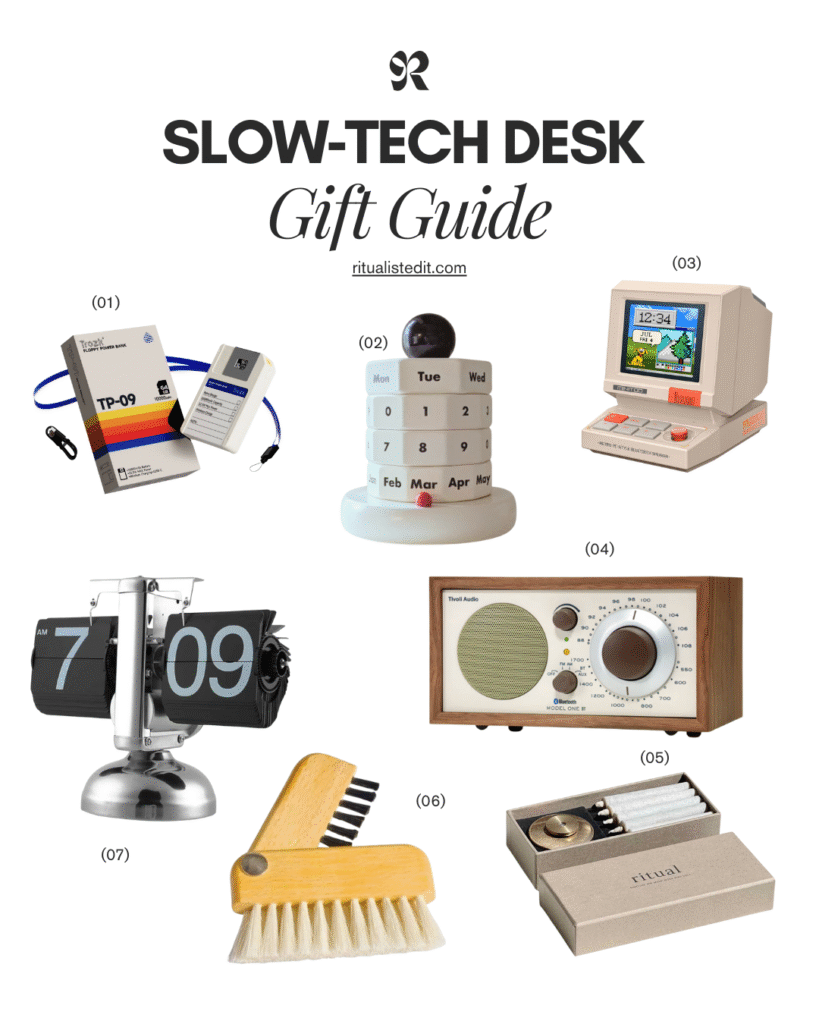
01. Trozk floppy magnetic power bank / 02. Tactile Calendar / 03. PicPak connected pixel display / 04. Model One analog radio / 05. 20 minutes Mindfulness Candle Set / 06. Redecker laptop brush / 07. Arcane Poet flip clock
The slow-tech desk is, ultimately, a small act of spatial thinking. It asks: what if my environment supported focus, rather than constantly interrupting it? The answer, it turns out, involves less technology rejection and more technology relocation. A flip clock here. A charging station there. A candle for the deep work hour. These are not grand gestures. They are quiet adjustments that, over time, add up to a calmer way of working.
And calm, in this economy, is no small thing.